
Outdoor advertising remains one of the most powerful media formats available. But buying space without any territorial logic, banking on volume to compensate for imprecision, is a strategy that costs a lot and returns little. Advertising saturation is real, the cognitive attention of passers-by is limited, and media owners sometimes sell inventory that nobody actually looks at.
The result is familiar: campaigns distributed everywhere, remembered nowhere, with an ROI that is difficult to justify. Multiplying contact points without selecting them is just adding noise to an already overcrowded space.
What changes the equation is the combination of well-negotiated media inventory and a territorial deployment logic built around real pedestrian flows. This is the approach COM’INVADER, a specialist in urban advertising for 15 years, applies to every campaign, from negotiating with media owners to on-the-ground quality control.
How do you optimize the ROI of an OOH and DOOH campaign?
Two levers genuinely move the needle on campaign ROI : direct negotiation with media owners to secure competitive rates, and location selection based on actual audience exposure rather than theoretical impressions. That is the condition under which each contact point generates a measurable conversion and the media budget becomes an investment rather than a cost.
Tactical CPM : what volume does not tell you
CPM (Cost per Thousand impressions) is a misleading indicator when read out of context. A thousand exposures to an audience that perfectly matches your customer profile have a very different tactical impact from ten thousand to a generic audience. It is not about the gross budget. It is about the fit between the chosen format and the real pedestrian flow in front of it, at the right time of day.
A well-positioned poster, on the right junction, at the right hour, can generate more memorability than several dozen formats bought in bulk. COM’INVADER builds this logic into every media inventory analysis. The goal is not broad coverage. It is precise reach.
Negotiating directly with media owners : what it changes in practice
Fifteen years of direct relationships with JCDecaux, Clear Channel, Posterscope and the other main media owners across Europe translate into two concrete advantages for advertisers: rates that you would not typically access through direct buying, and full transparency on how the budget is allocated. In OOH and DOOH media buying, knowing exactly what every euro is doing is not a minor detail.
OOH vs DOOH : building a media mix that actually works
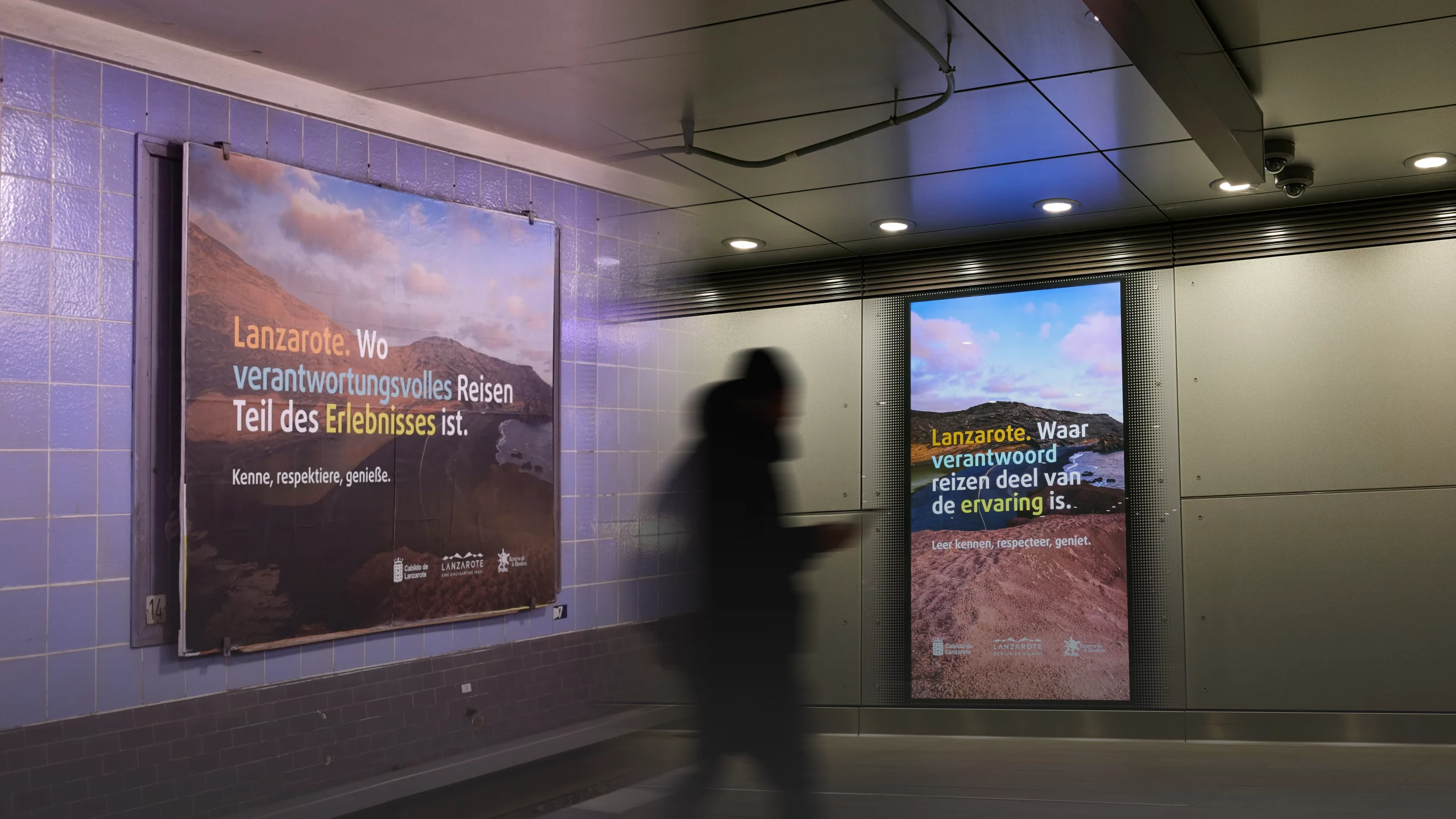
Opposing OOH and DOOH does not make much practical sense. Physical advertising builds a lasting presence and anchors the brand in a specific territory. Digital advertising adapts the message based on time of day, weather or local events, with a responsiveness that OOH simply cannot match. The campaigns that perform best combine both formats according to the objective of each phase.
OOH : what physical presence builds
A large-format poster on street furniture or a bus shelter does not generate performance in the digital sense of the word. It does something harder to quantify but just as real: it embeds a brand into the daily life of a catchment area. On a route taken every morning through a city like London, Hamburg or Lyon, repeated exposure creates a familiarity that carries weight at the moment of purchase. That is the specific logic of OOH, and it is why it holds its own against the saturation of digital channels.
DOOH and programmatic advertising : buying audiences, not locations
Urban digital advertising has moved well beyond the looping screen. DOOH (programmatic out-of-home) and RTB (Real-time bidding) allow advertisers to buy exposures on specific screens, at specific moments, in front of audiences identified through mobility data. In practice: a fast food offer displayed at lunchtime in an office district in Brussels or Manchester, a weather-triggered message activated automatically when the temperature exceeds 28 degrees, a retail visual synchronised with in-store stock levels.
Media inventory is no longer bought by location but by audience. It is a significant shift in paradigm, and it brings OOH and DOOH media buying much closer to the programmatic logic of digital advertising.
For a deeper look at the memorisation mechanisms generated by your media mix, see our dedicated article on impact and ad recall in outdoor advertising.
Geofencing, DCO, pedestrian flows : what technology actually changes
Geofencing, DCO and pedestrian flow analysis have transformed OOH and DOOH media buying into a tool for geolocated activation. A contact point is no longer defined solely by its position on a map, but by the audience passing in front of it and by the moment when that audience is in a position to convert. This granularity is what separates a generic media plan from an effective territorial activation.
Geofencing : concentrating impact where intent exists
Geofencing means defining an activation perimeter around a point of sale, a retail zone or an event, and broadcasting only within that radius. Passive coverage gives way to targeted activation. In practice, this might mean switching on screens within 200 metres of a shop on a Saturday morning and deactivating locations where the pedestrian flow does not justify the spend. Simple in principle. Powerful in effect.
DCO : when the message adapts without human intervention
Dynamic Creative Optimisation (DCO) automatically adjusts the visual based on real-time data: in-store stock levels, outdoor temperature, weekend sports results, cultural events in the neighbourhood. Rather than a single message running for the entire campaign period, each DOOH screen delivers a contact point that speaks to the audience of the moment. Attention is captured more effectively when the message feels relevant right here, right now.
Pedestrian flow analysis : what a map does not show you
Any supplier can buy advertising space. Analysing pedestrian flows by hour, identifying zones where cognitive attention is genuinely available, and building a territorial network that maximises the impact of every format is a different job altogether.
That is what COM’INVADER brings to every media plan, and it is what distinguishes a high-performing activation from a simple inventory of locations. For brands that rely on urban proximity, our expertise in media buying and urban advertising is the starting point for every on-the-ground recommendation.
Take action.
If your current media plan lacks clarity on ROI, or if you want to explore what negotiated rates and an optimised territorial network can concretely change for your campaigns, a diagnostic is the right place to start.
Measuring an advertising campaign : the indicators that actually count
Measuring an outdoor advertising campaign no longer means counting the number of people who walked past a panel. Attribution tools today allow advertisers to draw a direct line between OOH and DOOH media spend and concrete behaviours: a rise in in-store traffic via drive-to-store, a spike in Google searches measured as drive-to-web, or a progression in sales across a specific catchment area during the campaign period.
Which indicators to track, and why
The indicators that genuinely matter in an advertising campaign go beyond raw impressions. Footfall measures the physical flow to the point of sale over the campaign period. Real visibility is validated on the ground, not just on an order form. That distinction matters. Drive-to-web tracks the increase in online searches generated by the campaign. And brand recall studies confirm the actual imprint your brand leaves in the memory of city dwellers.
None of these indicators is reliable in isolation. It is their combination that gives a credible reading of advertising attribution and allows the next campaign to be planned with fewer unknowns.
COM’INVADER reporting: field first
Every campaign receives structured monitoring: location validation before launch, tracking during the campaign, and a post-campaign review with field data. Quality control is carried out directly on the ground. That is the only way to know what actually happened and to sharpen the recommendations for what comes next.
Advertising and street marketing : why the two together work better
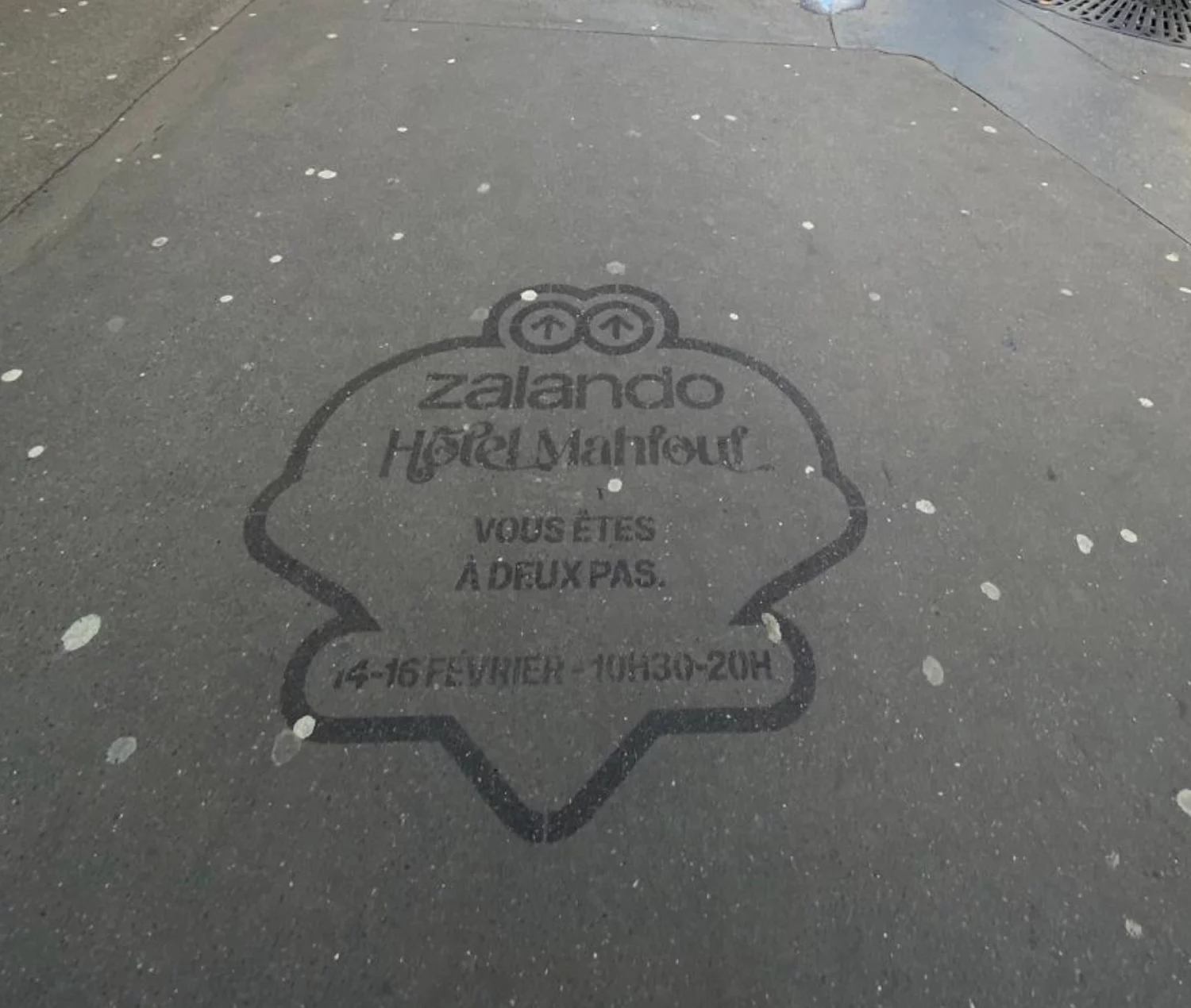
An OOH panel or a DOOH screen builds awareness and creates intent. But in many sectors, the purchase decision happens in the final metre, just before the entrance to a point of sale. That is where advertising alone reaches its natural limits, and where the combination with proximity devices makes real sense. Brands that activate both levels simultaneously get results that neither would have produced on its own.
The clean tag : the contact point that plays at the entrance
Eco-friendly floor marking (Clean Tag) is not a street marketing gimmick. It is a contact point positioned exactly where the decision is made: in front of a shop entrance, at the bottom of a retail street, at the precise spot where the intent generated by DOOH can convert into real behaviour.
What well-managed OOH and DOOH media buying changes for your ROI
Effective OOH and DOOH media buying depends on precise choices at every stage: media inventory negotiation, location selection based on real pedestrian flows, attribution tools to measure what is actually happening, and on-the-ground devices to convert exposure into action. There is no magic formula here. It is a craft. And it is what COM’INVADER has been practising for 15 years on behalf of its clients.
If your current media plan lacks clarity on ROI, or if you want to explore what negotiated rates and an optimised territorial network can concretely change for your campaigns, a diagnostic is the right place to start.