
Advertising saturation has changed the rules
The average city dweller encounters several thousand advertising messages every day. They remember almost none of them. This is not a creativity problem. It is a saturation problem. The brain has learnt to filter out what it has seen too many times.
This mechanism has a name : banner blindness. It affects the most widespread formats first. Large-format billboards, bus shelters, standardised street furniture. The more familiar a format, the more invisible it becomes. The eye scans it; the memory does not record it.
The answer is not to buy more space. It is to choose a different space, in the right place, at the right moment. That is what tactical urban advertising does : it replaces passive exposure with a point of contact the city dweller cannot ignore, precisely because they did not expect it there.
Why does tactical urban advertising produce better brand recall?
Because memory retains what breaks the expected pattern. A device installed somewhere the passer-by does not anticipate captures cognitive attention before they have even decided to look. This involuntary capture is what sets tactical impact apart from standard exposure, and it explains recall rates two to five times higher than equivalent formats.
The Brain and the break in routine
Attention is not a tap you open by raising your voice. It is a resource the brain allocates based on novelty. A repeated stimulus eventually stops generating a response. This is the principle of habituation. An unexpected stimulus, by contrast, automatically triggers priority processing.
Tactical urban advertising exploits this mechanism. A message printed on the ground of a busy shopping street, a device that plays with the perspective of a building facade, an installation that briefly alters the familiar landscape of a neighbourhood : in each case, the disruption creates attention before the content has had time to do its work.
Emotion as a memory anchor
Surprise triggers a micro-emotional reaction. Whether it is amusement, astonishment or curiosity, this reaction is far from incidental : it fixes the memory. The same mechanism explains why you remember a joke heard once but not a message seen a hundred times on the tube.
Ad recall scores measured after well-designed street marketing campaigns confirm this. Emotion and engagement go hand in hand, and their combination is what anchors the brand in the city dweller’s memory. A higher recall rate is not achieved by buying more space. It is achieved by placing advertising more precisely.
In practice, an effective tactical device produces four cumulative effects. It captures attention despite saturation by breaking the visual routine. It generates an emotional reaction, which fixes the brand in the memory. It creates a strong contextual association, where the location reinforces the relevance of the message. And it reduces competitive pressure, since less visual noise in the immediate environment translates directly into stronger net impact.
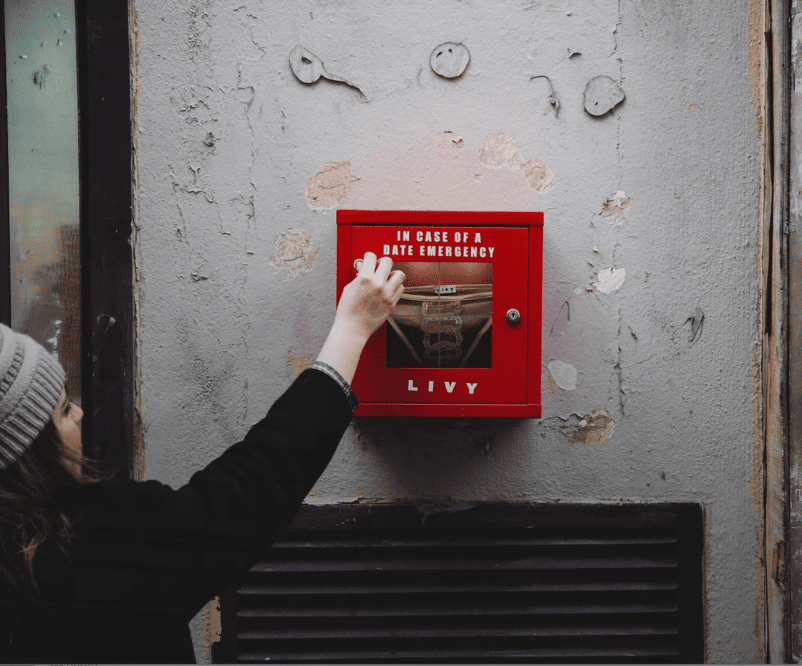
Surgical territorial coverage : choosing the location before the format
Contextual targeting is the backbone of tactical urban advertising. Before choosing a format or a message, you identify where your target audience is at the precise moment they are receptive. That is often just a few metres before a decision point : the entrance of a shop, a fork in a pedestrian flow, a natural waiting spot.
What knowing a territory really means
Surgical territorial coverage cannot be improvised. It requires a close reading of the terrain : analysis of pedestrian flows at different times of day, identification of decision zones, an understanding of behaviours specific to each neighbourhood in cities like London, Berlin, Amsterdam or Barcelona. This knowledge is what distinguishes a relevant location from a merely available one.
Com’Invader‘s comprehensive approach is built on this groundwork. Before each campaign, a field audit is used to select high-value contextual contact points : the ones that place the brand message exactly where it makes sense for the intended audience.
Floor marking : a precision tool
Among the available tools, eco-friendly floor marking has a particular advantage : it uses the natural downward direction of the gaze, where visual competition is almost non-existent. The passer-by has nothing to navigate around, nothing to decode. The message is simply there, in their path.
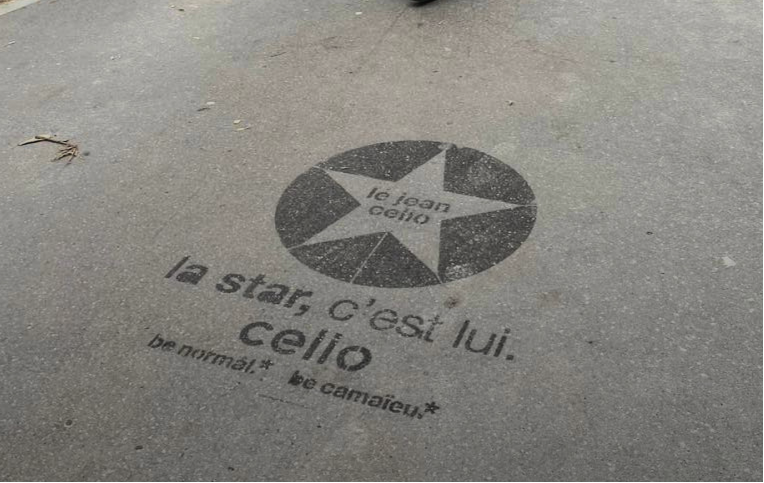
Its biodegradable nature makes it a genuinely responsible guerrilla marketing tool : effective over time, without lasting residue, and compatible with the growing requirements of city authorities regarding eco-responsible communication in public spaces.
How do you measure the effectiveness of an urban advertising campaign?
Three things matter : what happens at the point of contact (footfall), what happens afterwards (conversion), and what people say (spontaneous awareness). These three families of KPIs are enough to build a solid ROI, provided the device is designed from the outset with built-in measurement points.
The indicators that actually count
The marketing KPIs for a non-conventional out-of-home campaign can be read at several levels. Qualified pedestrian footfall is measured by comparing traffic at the selected locations before and during the campaign, cross-referenced with sales data in the area. Conversion rate tracks in-store visits or purchase acts in the catchment area during the campaign period. Brand searches are also revealing : a spike in Google queries in the days following deployment is one of the most reliable signals of genuine tactical impact. Finally, social media mentions matter : a sufficiently original device generates spontaneous content on social platforms, photos and videos, without any additional budget.
The Drive-to-Store effect : from the pavement to the point of sale
The drive-to-store effect is one of the most concrete arguments in favour of tactical urban advertising. A device placed a few minutes’ walk or a few metres from a point of sale can trigger a visit that was not planned. This direct link between physical stimulus and immediate purchasing behaviour is difficult to achieve with digital formats, which operate on a different timeline and in a different space.
When physical amplifies digital
Tactical advertising does not compete with digital media. It feeds them. A remarkable device generates content shared on Instagram or TikTok, pushes up brand searches on Google, and creates a geolocated audience that retargeting campaigns can then reach.
The physical device becomes the first point of contact in a multi-channel journey : it is what initiates the intent, and the digital that converts it. This complementarity is one of the reasons why campaigns integrating non-conventional urban advertising consistently deliver stronger digital results than fully online campaigns targeting equivalent audiences.
Rethinking your OOH and DOOH strategy, concretely
Tactical urban advertising does not replace traditional campaigns. It makes them smarter and more effective. By combining the responsiveness of Out-of-Home (OOH) and Digital Out-of-Home (DOOH) with the proximity of street marketing, Com’Invader’s expertise enables the design of hybrid, bespoke devices.
With this approach, the challenge goes beyond simply selecting a medium, whether digital or ephemeral. The real shift is strategic: the question is no longer just how to “buy visibility”, but how to identify the media mix capable of maximising recall impact at the right moment in the customer journey.
Switch to advertising that actually gets noticed
Got a launch to amplify or an audience to reach in the city centre ? COM’INVADER designs bespoke urban advertising campaigns : field audit, contact point selection, deployment and results tracking.
Tell us about your project. We’ll get back to you quickly !